Building is the easy part. The hard part is knowing if anyone will pay and how big the opportunity is. These are the eight terms every builder should be able to use before writing a single line of code.
Sizing the market: TAM, SAM, SOM
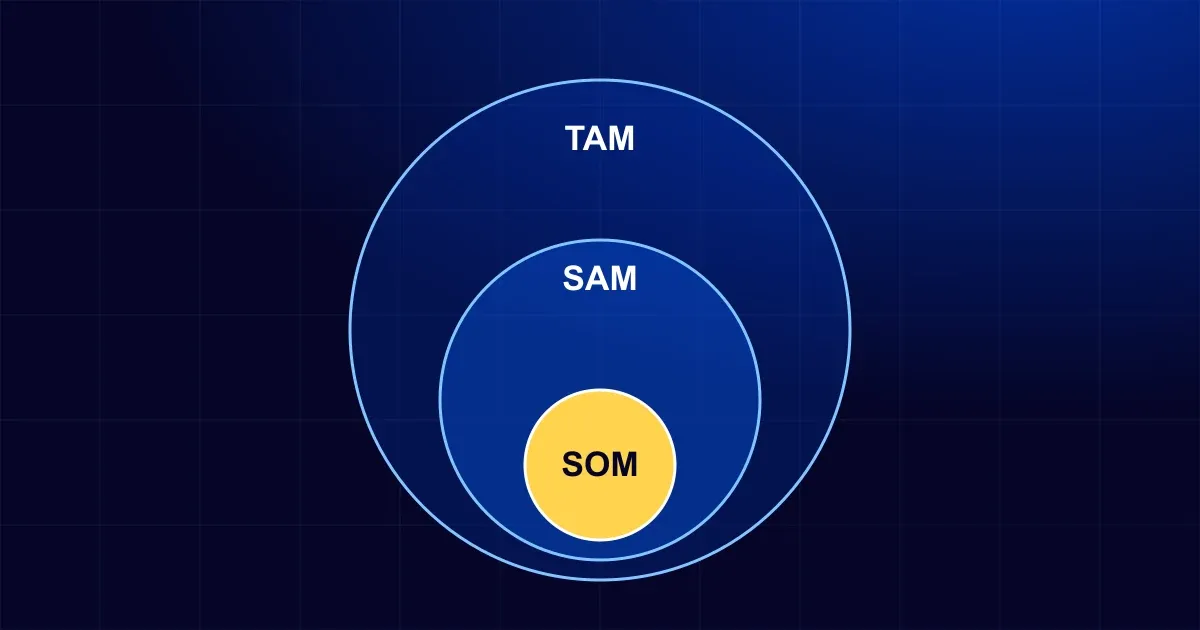
Three nested circles answer “how big can this get?”:
- TAM (Total Addressable Market): all the demand that exists if you owned 100% of the global market.
- SAM (Serviceable Available Market): the slice of the TAM you can actually reach with your current product and model (only LATAM, only SMBs, only Spanish speakers).
- SOM (Serviceable Obtainable Market): the share of the SAM you can realistically win in the next 1–3 years given competitors and resources.
Example: a scheduling tool for barbershops. TAM: every appointment-based business worldwide. SAM: barbershops and salons in Latin America. SOM: the 500 shops you can onboard this year.
Investors care about TAM. You should care about SOM: it is the number your next 12 months depend on. Build it bottom-up (number of customers × price) instead of quoting “1% of a huge market”.
Red Ocean vs. Blue Ocean
- Red Ocean: a saturated market where everyone fights on price and features.
- Blue Ocean: a new or ignored space where you create demand and have no direct competitor.
Most real businesses sit in between. You don’t need an empty market, you need a segment competitors serve badly.
Who exactly are you building for? ICP
Your ICP (Ideal Customer Profile) is the exact type of company or user who gets the most value from your product, pays fastest and cancels least. “Small businesses” is not an ICP. “Independent clinics with 2–10 staff that still book by WhatsApp” is.
A good ICP makes everything cheaper: messaging, channels, pricing, and the features you say no to.
MVP: the cheapest experiment
An MVP (Minimum Viable Product) is the simplest version that can validate one hypothesis with real users. It is not a bad product, it is a focused experiment. Often it is a landing page, a spreadsheet, or a manual service pretending to be software.
Write the hypothesis first: “Barbershop owners will pay $15/month to stop no-shows.” Then build only what tests it.
PMF: the signal you’ve been waiting for
Product-Market Fit means your product solves a real problem so well that the market pulls it from you. Signals:
- Retention flattens instead of decaying to zero.
- Customers come by referral without being asked.
- You are scrambling to keep up with demand, not chasing leads.
- If you removed the product, users would be genuinely upset.
Before PMF, optimize learning. After PMF, optimize growth. Mixing the order burns money.
Moat: why they can’t copy you
A moat is a structural advantage that makes you hard to copy:
- Network effects: each user makes the product better for the others.
- Switching costs: leaving is painful (data, integrations, habits).
- Proprietary data: you learn something nobody else can.
- Brand and trust: especially strong in finance and health.
Speed is not a moat. Features are not a moat. Ask: “If a funded competitor copied us tomorrow, why would customers stay?”
Pivot: change direction, keep the learning
A pivot is a deliberate change of segment, business model or value proposition, keeping what you learned. It is not failure, it is the normal outcome of testing hypotheses. Pivot when the data says so (flat retention, no one willing to pay), not when you are bored.
A checklist before you build
- Can I name my ICP in one sentence?
- Is my SOM big enough to be a real business?
- What is the one hypothesis my MVP tests?
- What would PMF look like in numbers?
- What is my moat, even if small today?
Next in the series: the SaaS metrics that tell you if you are actually growing.